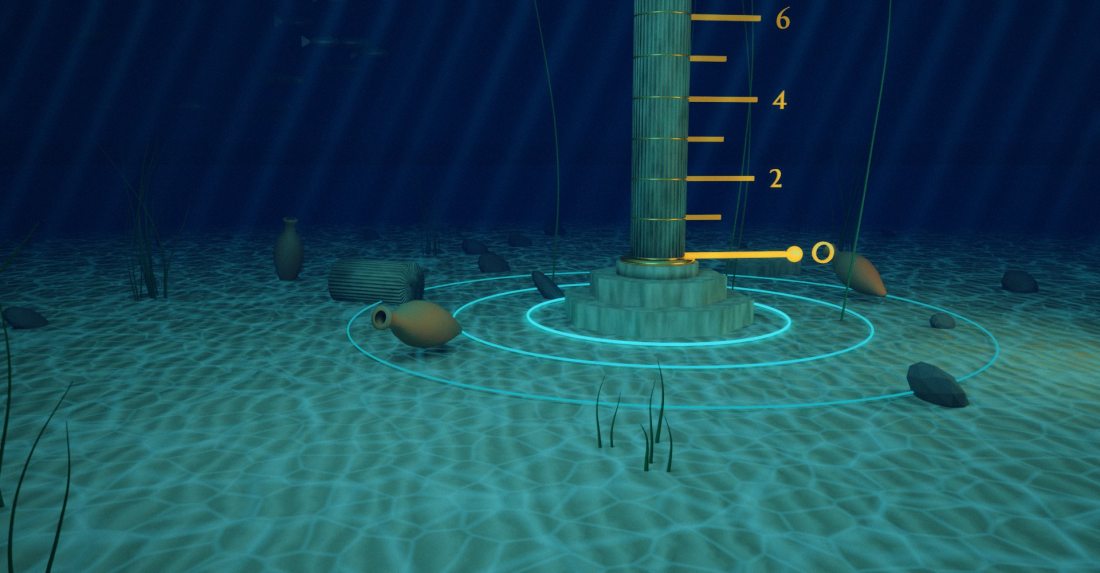
Know the depth before you dive.
Nilometer is an open experiment on EscapeHub with one working tool: Lens Check, our Telegram bot. Paste a Solana token address and it reads the chain for you, then says in plain words how deep the pool is, who holds what, and what is locked.
Lens Check is the bot of the Nilometer project. The basic check is free and needs only a token address.

- Token
- NILO, on Solana
- Status
- Token address
Egypt read the river before it planted.
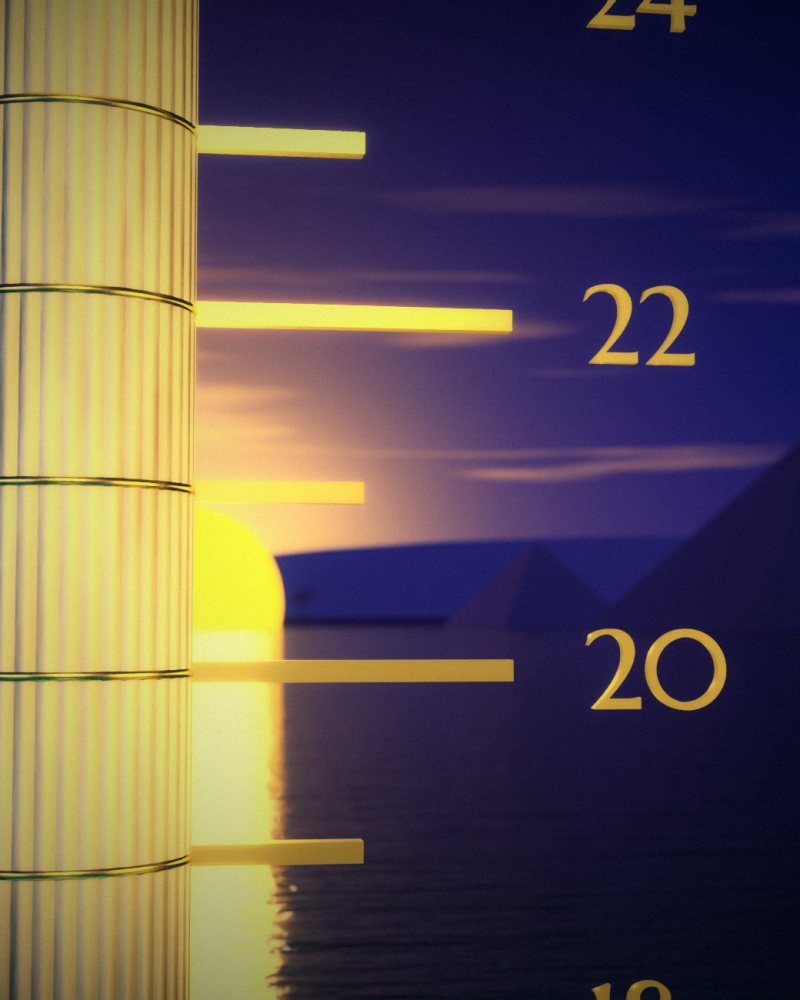
A nilometer is a graduated column standing in a well fed by the Nile. For thousands of years it told Egypt how high the flood would climb, and with it how the harvest would go and what taxes were fair.
Pliny the Elder wrote the scale down. Twelve cubits meant hunger. Fourteen, cheer. Sixteen, delight.
We kept the habit and changed the river. Before you step into a token, read the level.
- 16delight
- 15safety
- 14cheer
- 13still hungry
- 12hunger
The flood scale as Pliny recorded it, in cubits. Our column stands at 16.
Lens Check answers four questions a chart cannot
Lens Check is the Telegram bot of the Nilometer project. You paste a token address. It reads the pool, the holders and the locks from the chain at that moment and writes you a short report. Here is a sample, with our notes beside it.
Sample report. The token and every number in it are invented for illustration.
Lens Check · Sample Token (SMPL) · 9wEx…ampL
Supply: 1.00B tokens
Medium pool
A 1 SOL buy moves the price about +2.4%.
Pool · EscapeSwap
84.0 SOL deep
paired with 210.00M tokens
Price: 0.4 SOL per 1M tokens
Market cap: about 400.00 SOL
The pool authority holds another 31.50 SOL outside this pool. Not counted.
If you buy
Buy      You lose     Price
1 SOL        1.2%     +2.4%
2 SOL        2.3%     +4.8%
5 SOL        5.6%    +12.3%
14 SOL      14.3%    +36.1%
If holders sell
Sold            Price   SOL
0.5% of supply  -4.6%  1.95
1% of supply    -8.9%  3.82
5% of supply   -34.8%  16.2
The biggest wallet holds 6.2% of supply. If it sold everything: price down 40%, for about 19.1 SOL before fees.
Locks
12.0% of supply locked (120.00M tokens)
Locked tokens sit in a contract until a set date and cannot be sold before it. A lock can be made cancellable: i do not check that.
Unlock schedule on Jupiter Lock
Holders (pools and locks excluded)
31.4% held by the top 10 wallets
Biggest wallet: 6.20%
How to read this
Read from the chain at 11:00 UTC. Estimates, not financial advice.
Lens Check is the bot of the Nilometer project.
Built and checked on real EscapeHub tokens, on the bonding curve and on EscapeSwap pools. Every line is explained in the guide below.
How to read a report
Every report keeps the same order: the verdict first, then the numbers behind it. Here is what each line means, so you can check the reading yourself.
Three ways to ask
- 9wEx…ampL
Paste a token address. You get the full report. /check followed by the address does the same.
- /impact 9wEx…ampL 3
Add your own size. You get what a buy of 3 SOL does: how many fewer tokens you receive and where the price ends.
- /feedback your message
Talk to us. A bug, an idea, a comment. It reaches the team, as does the form on this page.
The colour is the depth of the pool
The colour answers one question: how far would a buy of 1 SOL move the price? The less it moves, the deeper the pool. With the pool math the bot uses, each colour matches a rough amount of SOL in the pool.
- Deep poolunder 2%about 100 SOL or more
- Medium pool2 to 8%about 25 to 100 SOL
- Shallow pool8 to 20%about 10 to 25 SOL
- Very shallow poolabove 20%under about 10 SOL
No colour means no pool was found, or the pool is of a type the bot cannot simulate. The colour rates depth and nothing else: it does not judge the team, the code or where the price goes next. A deep pool can belong to a poor project, and a shallow one can simply be young.
Line by line
- Name
- The name and ticker written on the chain by whoever created the token. Anyone can give a token any name, and fakes copy real ones. Trust the address, not the name.
- Depth
- The SOL in the pool that backs the price, with the tokens paired with it. In the bar each block is about double the one before: 5 blocks are about 32 SOL, a full bar is 1,000 SOL or more.
- Price and market cap
- The price is quoted in SOL per 1 million tokens. Market cap is that price multiplied by the whole supply, in SOL.
- Outside this pool
- On EscapeSwap one account keeps the SOL of many pools. The report counts only the SOL of the pool you asked about and tells you how much it left out.
- You lose
- For a buy of that size, how many fewer tokens you receive than at today's price. Swap screens call it price impact. Fees come on top.
- Price, in the tables
- Where the price ends after that trade: up after a buy, down after a sale.
- Sold
- What happens if holders sell that share of the whole supply in one go.
- SOL, in the sell table
- What that sale would bring in. On a pool the figure is before fees. On a bonding curve the curve fee is already taken off.
- The biggest wallet
- The largest ordinary wallet. The report shows the damage if it sold everything at once, and how many SOL it would take out of the pool.
- Locks
- Tokens held in Jupiter Lock among the 20 largest accounts, as a share of supply. They sit in a contract until a set date and cannot be sold before it. One block of the bar is 10%. The link opens the unlock schedule. A lock can be created so that it can be cancelled: the bot does not check that yet.
- Holders
- The share of supply held by the ten biggest ordinary wallets. Pools, locks and other contracts are not counted.
A token still on the bonding curve
A new token on EscapeHub does not start in a pool. EscapeHub sells it along a bonding curve: a price rule where every buy pushes the price up and every sale brings it back down. Lens Check reads that stage too. The verdict then says still on the bonding curve, and the pool block looks like the sample shown here.
Bonding curve · EscapeHub
33.5% of the curve sold
9.88 SOL raised, about 85.0 SOL fill the curve
Price: 0.0494 SOL per 1M tokens
Market cap: about 49.41 SOL
Curve fee: 1.2% on every buy and sell. The tables take it off the SOL you pay and the SOL sellers get. You lose does not count it
A new curve prices its token as if it already held 30.0 SOL. That SOL is virtual: sellers can take out at most the 9.88 SOL raised so far.
The curve also holds 206.90M tokens that are not for sale on it.
- Of the curve sold
- How much of what the curve has for sale is already bought. One block of the bar is 10%.
- SOL raised
- The real SOL paid in so far, and about how much buys everything the curve has. On the curves we have read it takes about 85 SOL.
- Virtual SOL
- A new curve prices its token as if it already held 30 SOL. Nobody paid that SOL in. It only sets the starting price, so sellers can take out no more than the SOL really raised.
- Curve fee
- 1.2% on every buy and every sale. The tables take it off the SOL you pay and the SOL sellers get. You lose does not count it.
- Not for sale on it
- The curve also holds tokens it does not sell. The report tells you how many.
- Holders
- The curve itself is not counted as a holder. One extra line says what share of the tokens that have left the curve the top 10 wallets hold.
- The colour
- It works as for a pool. A curve that has just opened reads as a medium pool: a 1 SOL buy moves its price by about 6.7%.
- When the curve is complete
- Nothing is left to buy on it and trading moves to a pool. If the report shows no pool yet, the move is still pending or the pool is of a type the bot cannot read.
What a report cannot tell you
- It is a snapshot. The chain is read when you ask, and the same reading is reused for 60 seconds. A minute later the numbers can differ.
- It is an estimate. The bot uses simple constant-product math. Pool fees are left out. On the bonding curve the 1.2% fee is counted.
- It sees the 20 largest accounts. Locks or wallets below them are not counted.
- It was built on EscapeHub. It reads the bonding curve and EscapeSwap pools. For other pool types it can show less, and it says so. If the numbers of a curve do not add up, it shows none.
- A name proves nothing. The report shows the name the creator chose. Check the address.
- It is not a safety check. Treat it as one input, verify on the chain, and decide for yourself. Not financial advice.
The same order moves a shallow pool far more than a deep one
Move the two sliders. This is the arithmetic Lens Check does for you on a real pool.
- Price moves
- +4.8%
- You pay, on average
- 2.3%above the starting price
Constant-product pool, fees not included. An illustration, not a quote.
NILO is a key you keep in your pocket
Nothing is spent and nothing is staked. Lens Check looks at how much NILO a wallet holds and opens more of itself. The basic check stays free for everyone.
- 0NILO
Everyone
The on-chain check, free: 5 a day.
- 0.01%of supply
Holder
Unlimited checks, plus the unlock calendar.
- 0.1%of supply
Pro
Everything a Holder gets, plus automatic alerts.
- Holder and Pro thresholds can only go down. The free limit can only go up.
- Holder and Pro features are not live on launch day. They switch on within 7 days, and the free limit starts only then.
- Lens Check stays online at least until 28 February 2027, whatever happens to the token.
- Lens Check will never ask for your seed phrase or your private key.
The rules, written down before launch
We hold NILO too. This is how much, where it sits, and what we can and cannot do with it. Every line can be checked on the chain.
How much the team holds
- Founder, locked 6 months1.5%
- Founder, free0.5%
- Co-founder, locked 6 months0.5%
- Co-founder, free0.5%
What we commit to
- No free tokens
- The team buys on the bonding curve, under the same price rule as anyone. One purchase, made by the founder's wallet inside the creation transaction.
- Team cap: 3%
- Three percent of the supply for the two of us together. That is the ceiling, not a starting point.
- 2% locked for 6 months
- Locked on Jupiter Lock within 24 hours of launch. The lock link goes on this page.
- 1% free
- Half a percent each. It can be sold at any time, and we are telling you so now.
- 7 days' notice
- When the lock ends, any sale of that part is announced in public 7 days ahead.
- Creator fee: 0.50%
- EscapeHub pays the token creator 0.50% of every trade on the curve. We keep it, and we say so here.
- No whitelist, no presale
- Nobody gets in early. The first purchase is ours, it is declared above, and it counts toward the 3%.
- No price promises
- NILO is an experiment with a utility. We will never tell you where its price is going, because we do not know.
Check it yourself
- NILO token
- Founder wallet
- Co-founder wallet
- The 6-month lock
Written on 28 November 2026, before the token existed.
Why we launch on EscapeHub
We are part of the Escape community, and Lens Check was first built to read the tokens we hold there ourselves. Launching anywhere else would make no sense.
A launchpad gets stronger when the people on it can read what they are buying. That is the piece we want to add to this ecosystem.
Nilometer is an independent project. EscapeHub does not operate, endorse or audit it.
What EscapeHub's rules give every launch
- Creating a token costs only the network fee.
- One bonding curve, one price rule for every buyer.
- When the curve completes, the liquidity is locked for good.
As published by EscapeHub. See their documentation for the current terms.
What happens, and when
- Launch dayThe token is created on EscapeHub, with our single declared purchase in the same transaction. The addresses appear on this page.
- Within 24 hours2% of the supply goes into Jupiter Lock for 6 months. The link appears here.
- Within 7 daysHolder and Pro features switch on in Lens Check.
- Until 28 February 2027, at leastLens Check stays online.
- Six months after the lockThe 2% unlocks. Any sale is announced 7 days ahead.
Who is behind it

Founder
Medical doctor and dental surgeon
He works in endodontics: finding and treating the canal system hidden inside the most difficult teeth. Other practices call him in as a consultant on their hard cases. He looks at a token the same way, going deep and searching for the problem before committing. Lens Check is that habit turned into a tool.

Co-founder
Engineer
Every project needs someone who keeps the engine running while everyone else watches the chart. That's SilentHodler. An engineer with a broad technical culture, he is the technical right hand of the founder, at every step from the first idea to launch. Low profile, high conviction: he doesn't talk much, he ships.
A professional background is not financial expertise. Nothing on this site is investment advice.
Questions worth asking
Is NILO an investment?
No. It is an experiment to see whether a useful tool creates real interest. The price can fall to zero. If you buy, use only money you could lose without it mattering. You can also buy nothing: the basic check is free.
Do I need NILO to use Lens Check?
No. Anyone can run the basic check. Holding NILO opens the extra features.
Is NILO spent when I use the bot?
No. Lens Check reads the balance of your wallet. The tokens never leave it.
Can the team sell?
The free 1% can be sold at any time. The locked 2% cannot move for 6 months, and after that any sale is announced 7 days ahead. The team never holds more than 3%.
What does the team earn?
The creator fee that EscapeHub pays on trades (0.50% on the curve), and whatever its own 3% is worth. There is no presale, no paid plan and no free allocation.
Is Lens Check always right?
No. It reads on-chain data and applies simple pool math without fees, so it can be wrong or out of date. Treat it as one input and check the chain yourself. The addresses on this page are there for that.
Is Nilometer part of EscapeHub?
No. It is an independent project launched on EscapeHub. The bot's handle contains the word Escape because it was first built to read Escape tokens.
Is it related to other projects with a similar name?
No. Nilometer has no connection with any other company, product or token called Nilo, Nilometer or anything similar.
What if nobody cares?
Then the experiment has given its answer, and that is a result too. Lens Check stays online at least until 28 February 2027 either way.
Tell us what is wrong or missing
Lens Check is young. If a report looks wrong, if a pool is not found, or if you want it to do something more, write it here. It reaches the two of us.
- Write your message and press the button.
- Telegram opens on Lens Check with your text ready. Press send.
- The bot confirms and passes it on. If it needs an answer, we reply there.